Why Fixed Appliances Are Still the Standard for Traction
When an impacted canine is surgically exposed and bonded, the tooth needs to be pulled through bone and gum tissue along a specific path, often while also being rotated into correct alignment. A fixed bracket and chain can give us the most direct, predictable control over that force, which is why sometimes I still recommend traditional braces for the traction phase in some of my patients we treat.
How Clear Aligners Can Be Used in Select Cases
Clear aligner systems have advanced enough that they can also manage an impacted canine once it has been exposed. This typically requires bonded attachments or buttons on the tooth to serve as anchor points, along with elastics worn between the aligner and the exposed tooth to apply the necessary directional force. This approach tends to work best when the impaction is mild to moderate .
A Hybrid Approach: Braces to Guide, Aligners to Finish
For many patients, the most practical solution is a hybrid one. Aligners are used to open the space, partial braces in the impacted tooth area handle the traction phase, when precise, controlled force matters most, and clear aligners take over once the canine has reached the arch and only refinement remains. As Atlantic Canada’s largest clear aligner provider, we offer both Angel Aligner and Invisalign, and we frequently use Angel Aligner as the primary system for comprehensive cases like this.
What We Consider Before Recommending Aligners for Your Case
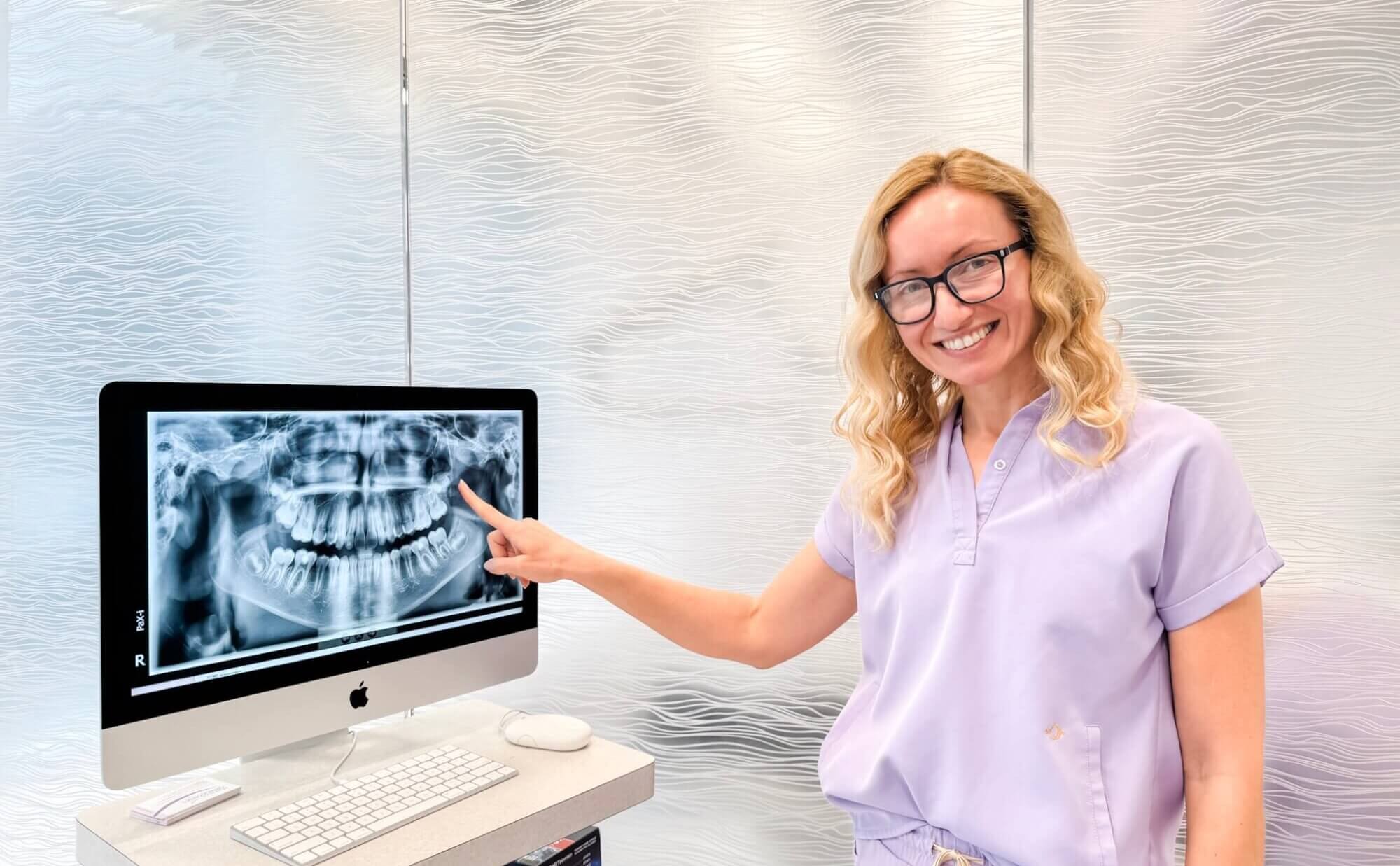
Before recommending an aligner-based or hybrid approach, Dr. MacKenzie evaluates the tooth’s depth, angle, and rotation using panoramic and, when needed, 3D cone-beam imaging at the oral surgeon’s office. Dr. MacKenzie also weigh the patient’s age, motivation, and compliance with aligner wear. There is no single right answer for every patient, which is why this decision is made individually at your consultation rather than assumed in advance.