
What is an overbite?
An overbite is how much the upper front teeth overlap the lower front teeth from top to bottom. When the overlap is excessive, sometimes covering the lower front teeth almost completely, it is called a deep bite.
Our blog post Can Invisalign Correct an Overbite? explains how aligners treat it.
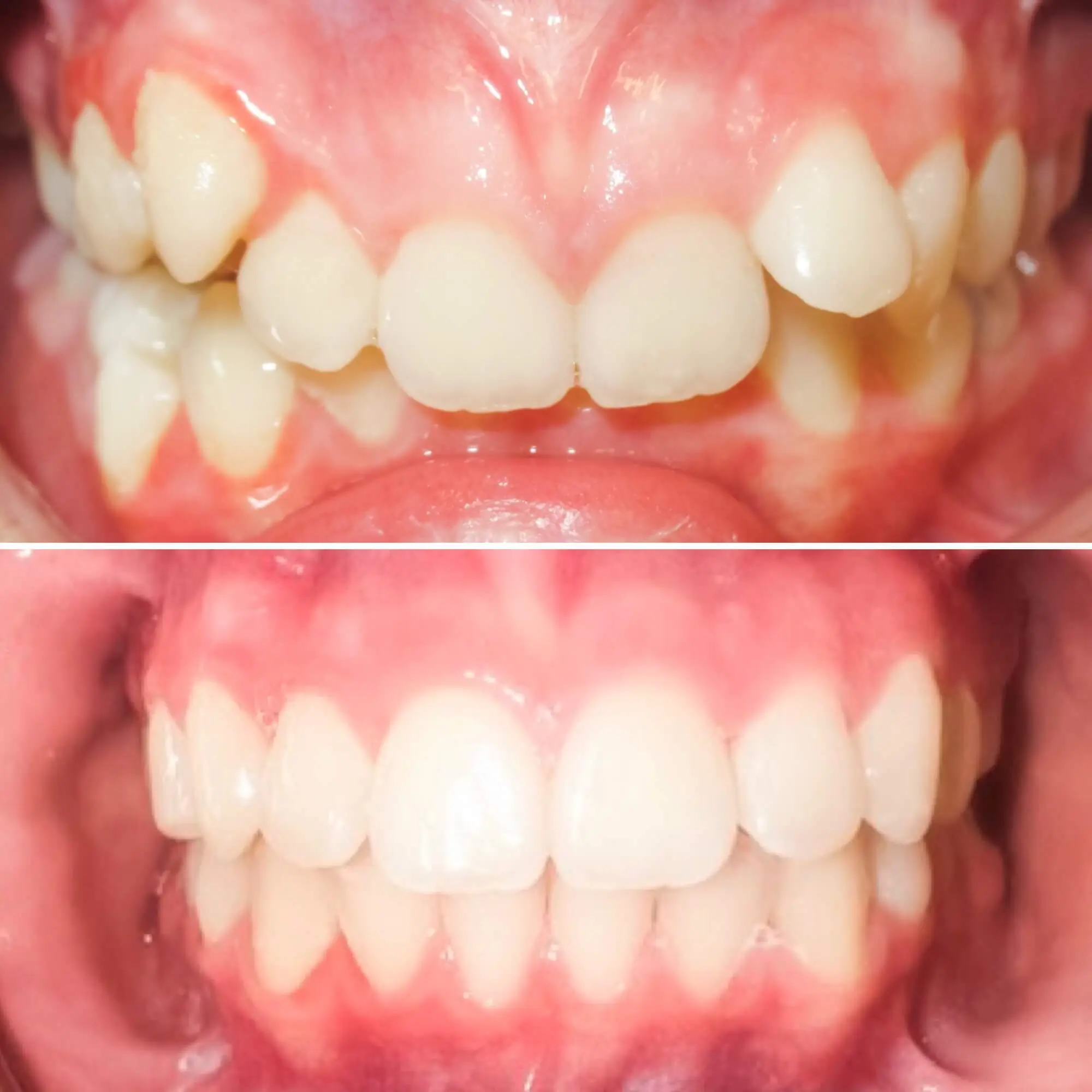
Is an overbite the same as buck teeth?
Not quite. Upper front teeth that stick out forward, often called buck teeth, are what orthodontists call an overjet, while an overbite is the overlap from top to bottom.
In everyday speech the two words are often swapped, and our Orthodontic Issues We Treat page notes that excess overjet is often called an overbite. Read What Is an Overjet and How to Treat It.
Why should a deep overbite be treated?
A deep overbite can wear down the lower front teeth and irritate the gums behind the upper front teeth or the roof of the mouth. It may also contribute to jaw discomfort or TMJ symptoms.
Signs to watch for include lower front teeth that disappear behind the upper teeth when you bite, lower teeth that look worn, and sore spots behind the upper front teeth. An overbite can also affect speech and the balance of the smile. If your jaw aches or clicks, see our TMJ Treatment page.
How do you treat an overbite?
We use braces or clear aligners, Angel Aligner or Invisalign, to gradually adjust the depth of the bite. Dr. MacKenzie recommends the option that suits your teeth and your bite.
With braces you can choose silver with colours, clear ceramic or self-ligating. When treatment ends, retainers hold the teeth in their new positions. See Braces, Invisalign and Clear Aligners and Retainers.
Can clear aligners fix an overbite?
Yes, for many teens and adults. With the right treatment plan and consistent wear, clear aligners can treat mild and even moderate to severe overbites.
You wear your aligners 22 hours a day and take them out to eat and to brush and floss. A typical overbite correction takes 12 to 24 months, depending on severity and how consistently the aligners are worn. Read Can Invisalign Correct an Overbite? and, for teens, Treatment for Teens.
When should a child with an overbite see an orthodontist?
By age 7. The Canadian Association of Orthodontists recommends a first orthodontic evaluation by that age, and early evaluation is always free at MacKenzie Orthodontics.
At around 7, Dr. MacKenzie can evaluate deep bites and see how the upper and lower jaws are growing. Most children are simply monitored at free growth visits, but severe overbites are one of the problems Phase 1 treatment can correct while the jaw is still growing. See Aligners and Palatal Expanders for Kids and growth monitoring for kids.
Does an overbite need jaw surgery?
Many do not. Jaw surgery is considered in adults when the upper or lower jaw protrudes to a degree that orthodontic treatment alone cannot resolve.
Surgery is done by an oral and maxillofacial surgeon, and we provide the orthodontic treatment before and after it. We give non-surgical options to every patient who would benefit from treatment. Read Orthognathic Surgery.
How much does overbite treatment cost?
Your fee depends on your treatment plan, and we go through it with you at your free consultation. We offer 0% interest monthly payment plans and direct bill most major insurance providers.
Low or no down payment options and pay-in-full discounts are available, and there is no tax on our payments. See Cost, Insurance, and Financing.
Is your bite, or your child’s, deeper than it should be? Book a free consultation in Saint John, Quispamsis or St. Stephen. It includes digital x-rays, clinical photos, a 3D intraoral scan and a personalized smile simulation, at no cost and with no obligation.